Postures in Hatha Yoga
Yoga postures are the third step of Hatha Yoga as defined by Patanjali.
The only visible step of Yoga practice...
Yoga postures restore the body to proper functioning so that it can support the other steps of Yoga, and they reveal to us the energetic architecture of our body.
So each posture holds the possibility of revealing a secret of our body to us, whether by identification with the form (fish, tiger...), with the energy centres (chakras), or with an infinity of inner beauties that we can experience directly and in which pranayama will play a very important role.
Since everyone must do their best with their own body, clearly the outer form of the posture is not what really matters. The idea of a perfect posture only makes sense in a photo or a book, where the search for colour excels, but not really in Yoga.
Only the fundamental axes of a posture matter, and above all the intention that sets it in motion. So Yoga is open to everyone, flexible or less flexible, thin or overweight, strong or weak, young or old...
Our world, which loves the sensational and above all images, tends to see Yoga as nothing more than a series of postures, forgetting its ultimate goal, that of living deep meditation, Samadhi.
Some even take this to the extreme and try to create a Yoga World Championship, where fine athletes compete to show off their great flexibility and their ability to perform the most aesthetic contortions possible. Sadly, this approach seems very ego-driven, and it all tends to make me a little sad...
What will become of Yoga in the years to come?
The Western world tends to classify everything, and at the speed things are going, I think Yoga will soon be treated as a mere sport, its “spiritual” side reduced to an old belief or an old superstition...
In Yoga there are more than 32,000 postures; only a dozen are said to be fundamental, and only one important, the Lotus.
Not wishing to fall into this error of the image, I will show only one posture on my whole site, remarkable for the Yogi's "determined" gaze and his presence (...).
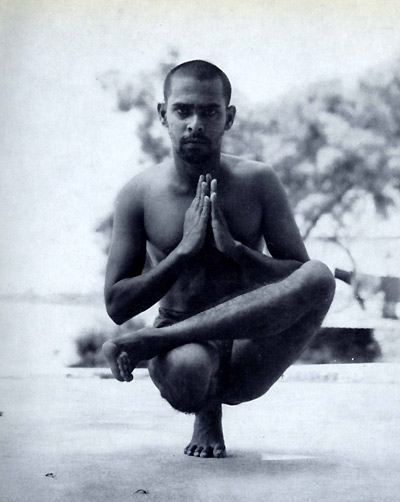
Swami Vishnudevananda photographed by Louis Frédéric.
The Internet, the great master of images, and esoteric shops will give you every satisfaction if you are looking for beautiful postures...
I see a posture, like every approach in Yoga, rather through 3 energies, namely Iccha, Jnana, Kriya...
Iccha the will, which is not the simple will to do but rather the will to forget oneself and transcend the act: it is the posture that happens, not we who do the posture.
The posture happens in our body because it is the archetype of a form that has existed since the dawn of time.
It is Jnana, knowledge, because it connects us to the tremendous single source from which multiplicity was born. It allows us to make contact with and know the elements (tattvas) that make up all things, so it allows us to know all things from within.
Finally, it is Kriya, pure act and perfect vibration (spanda). It must be freed in its form, freed from all mental constraint and limitation, like a spontaneous gesture, like a breath...
The posture is only the outer manifestation of a form born in the undivided depth of the spirit, and it allows consciousness to return there. It then becomes the motionless vehicle that brings everything back to point zero, to the beginning...
Dissecting and analysing it means getting lost in time and space, even as it tries to dissolve these axes of manifestation.
Asana prepares for the next step: Pranayama