Hatha Yoga
One cannot help noticing that the same articles on Hatha Yoga are copied and recopied from site to site, with the same more or less accurate approximations about what Hatha Yoga is supposed to be.
It would seem that very few practitioners open a few traditional texts to form their own idea of the subject, often preferring to stick to "teacher trainings" lasting only one or three months, where of course only a thin veneer can be glimpsed. One may wonder in which field of human activity it is possible to claim to be "a teacher" after only one or three months. None, it seems to me!
There are many traditional texts that speak of Hatha Yoga. I will draw on four of them to give an idea of this practice of Hatha Yoga, whose origins are lost in the mists of time.
I will leave aside somewhat the vision of Patanjali, who is in no way the creator of Hatha Yoga, as one unfortunately reads here and there. Patanjali compiled the tradition of Yoga and was the first man to attach his name to a text. His vision is that of a Yoga closer to Raja Yoga, the vision of an ascetic. Yet we are not ascetics, and very often the study of his text in many schools is limited to the eight steps (limbs of Hatha Yoga), and mainly Yama and Niyama (restraints and disciplines), adding ethical and moral notions pushed to extremes while forgetting his sublime presentation of Samyama (convergence) in his third book...
Hatha Yoga is not limited, as one unfortunately reads in many places, to a few postures done more or less well, more or less dynamically, with movement synchronised with the breath and a "relaxation" at the end of the class. This very poor presentation also tells us that the practice is well suited to beginners. These errors are even found in "federations" that claim to be "official", which they cannot be, since Yoga is not an activity regulated and recognised by the State in the way a sport is.
What does Hatha Yoga mean?
Hatha Yoga is the Yoga of effort. It is also called "the violent Yoga", where the violence is not directed outwards, nor at others or at oneself, but allows us to set out on the path with enthusiasm, strength, courage and honour…
Hatha Yoga comes from the sublime idea that HA is the Sun and THA is the Moon!
So Hatha Yoga aims at the union of the moon and the sun within the body.
How is this possible, and how does it work?
In the body there are three main energy channels (Nadis):
- On the left, Ida, related to the moon and the feminine
- On the right, Pingala, related to the sun and the masculine
- In the centre, Susumna, in which energy flows only twice for everyone: when the body is created in our mother's womb, and at the moment of our death.
All Yoga techniques work deeply on these three nadis, among other things, and this is very important! Here too, one cannot help noticing that there are thousands of books that try to tell us about postures seen through the body, always the body and its anatomy, but very, very few books speak of the secret anatomy of the energy body and the effects of the postures on it.
The aim of Hatha Yoga is therefore to saturate with energy the left/right, lunar/solar dualities, so that the energy dormant in the energy centre at the base (Mula Bandha) awakens. This energy is called Kundalini. Kundalini means "the coiled one", because once her work of creating the bodies and sealing all the planes is done, she falls asleep at the base of the body, coiled three and a half times around herself.
So Hatha Yoga is a Yoga focused on the awakening of Kundalini, which will bring illumination, awakening and deep knowledge (jnana) of existence, of the manifest, of the unmanifest and of the observer of phenomena, the Spirit (see Samkhya).
The word Yoga comes from the root YUG, which means to put under the yoke (the English word "yoke" shares this Sanskrit root), and what must be put under the yoke is our individual soul, which must find the divine universal soul again. That is true initiation!
Yoga is therefore about making the link with the divine, and not just with the body and our mind in an exhausting and highly marketed search for some hypothetical well-being.
I recommend opening Jean Papin's book: La Gheranda Samhita
Jean is a Yogi friend who has translated many texts with great knowledge and great clarity!
The Gheranda Samhita is the classic treatise on Hatha Yoga!
A samhita is a revealed text found in the Vedas...
In this text we are told that Hatha Yoga is made up of:
1/ The Dhauti, cleansing of the body
2/ Asana, the postures
3/ The mudrã, much more than simple finger gestures, mudras are also powerful postures combining asana and pranayama with the aim of awakening deep energies such as Kundalini
4/ Pranayama, which means lengthening the breath and mastering the vital energy, up to Kevala Kumbaka, the complete suspension of the breath!
5/ Pratyãhãra, the fusion of the senses
6/ Dhyãna, meditation
7/ Samãdhi, deep meditation, the complete stopping of the mind.
It is worth noting that in this very precise and traditional treatise on Hatha Yoga, Yama (restraints) and Niyama (disciplines) are absent, replaced by cleansings of the body...
We must also glimpse that a posture is not merely an outer form that should be more or less well "aligned", but a system of extraordinary power that should reveal to us secrets about our physical and psychic architecture, as well as our energetic architecture and other planes besides. In fact there are five bodies (koshas) that every practitioner should know and explore through all the techniques of Hatha Yoga...
For example, the posture Ardha Matsyendrasana, the posture of Matsyendranath, connects us, if we do everything required within it (bandhas, drishtis, pranayama and mantras), to this illustrious figure, the revealer of Hatha Yoga, who belongs to the Nath Sampradaya, the unbroken Tradition of masters and disciples at the source of Hatha Yoga. It is the origin of the name Natha. Bear in mind that anyone claiming the title "Nath" or "Natha" should have received a specific initiation (diksha) from a recognised master of the Nath Sampradaya, a diksha guru.
So this posture, Ardha Matsyendrasana (the half twist), should not just be seen from the outside: we must understand that it offers unimaginable secrets, for we can see that if the revealer of Hatha Yoga left us a posture bearing his name, he placed within it a very great knowledge that we can relive, come to know and above all discover!
To this overview of Hatha Yoga must be added practices that are rarely explained, if at all: the internal contractions (bandhas), the internal gestures (mudras), the many mantras, and also special ceremonies (pujas) that connect us to deities...
All of this is part of traditional Hatha Yoga!
I have written this in the hope that it will make you want to go a little further than simply practising postures, and that you will be able to taste all these sublime secrets of Hatha Yoga.
The four texts I recommend to truly understand what Hatha Yoga is are:
- Hatha Yoga Pradipika (translated by Tara Michaël)
- Gheranda Samhita (translated by Jean Papin)
- Shiva Samhita (translated by Jean Papin)
- And also the Goraksha Shataka (translated by Tara Michaël)
Happy practising, and wonderful discoveries!
Denis Billo
Abhinavagupta "The aim of Yoga is to reveal the divine within us."
Yogananda
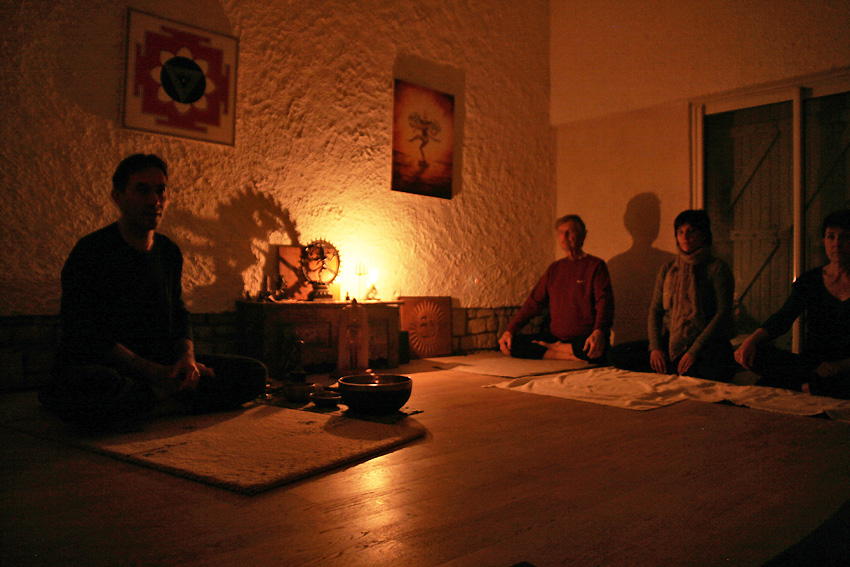
A former practice room in Grimaud