Study of the Samkhya tattvas
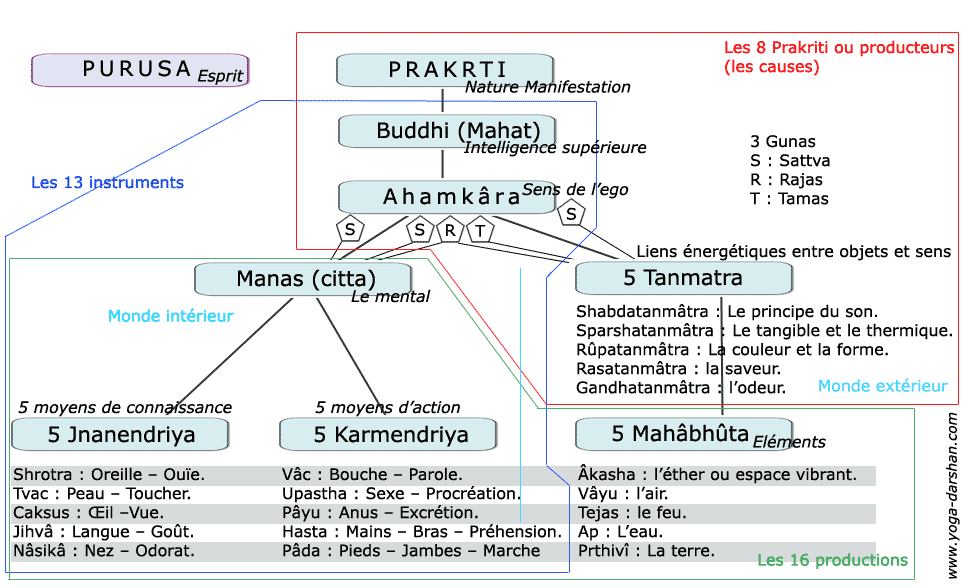
A view of the elements that constitute us
- The 16 are the productions.
- The 13 are the instruments.
- The 8 Prakriti are the producers (the causes).
- Prakriti is the substantial cause of manifestation; it is unconscious
- Purusha is the spirit, pure consciousness, the motionless spectator.
- Buddhi is the higher intelligence; it is produced by Prakriti.
- Ahamkara is produced by Buddhi; it brings the notion of ego, the idea of "I am".
- Ahamkara is sattvic in nature; its production, combined with the gunas (tamas, rajas, sattva), gives
(with one guna predominating) Manas, Jnanendriya, Karmendriya, Tanmatra.
- Manas is the mind; its functions are intellectualisation, memory and the perception of an inner and outer world.
- Jnanendriya and Karmendriya are not produced by Manas but by Ahamkara; Manas merely steers them.
- Prakriti, Buddhi and Ahamkara do not differ in nature.
- Buddhi is the individual selves.
- Ahamkara refers the fruit of action back to oneself.
- If in action we go beyond the idea of keeping the fruits of action for ourselves, we reach Buddhi.
- The tanmatras are potential capacities of perception.
- Mathematically, 3 gunas can combine to give 6 products. Yet there are only 5 Jnanendriya and 5 Karmendriya. This opens the possibility of a 6th sense, intuition, placed above Ahamkara.
- The human being is the only link able to experience the whole of creation.
The Gunas:
- Sattva is the influence of light. An orbiting, balanced force, light, pleasant and revealing.
- Rajas is the influence of action. A centrifugal force, movement; it is mobile and gives impetus.
- Tamas is the influence of inertia. A centripetal force; it is heavy and opaque.
- Nature does not change into consciousness but in its nature. It is the influence of the Gunas that changes under the influence of consciousness.
- Buddhi is the point of contact with PURUSHA (the spirit).
Since Buddhi is sattvic, it allows the practitioner to bring the consciousness of the being towards contact with Purusha, but wanting to develop Sattva alone is not necessarily good.
- Someone on too sattvic a path will not have enough strength to go far, nor enough torpor to come out of their luminous meditative state.
- Too Rajasic, they will not be able to keep still and live Sattva.
- Too Tamasic, they will be able to settle and keep still, but will fall asleep because they are apathetic.
- 3 elements form the veil: time, space and the link of causality.
A few of my favourite karikas
Karika 40: The Linga (subtle body) is formed beforehand, unattached, lasting until liberation, made up of the principles from Mahat down to the subtle elements (tanmatra). The Linga transmigrates, taking on several bodies in turn, celestial, human or animal, and is unable to experience anything if it lacks a gross body or vehicle body. The linga is imbued with various potentialities.
This subtle body, which transmigrates from life to life, keeps "the trace" of our experiences, good or bad, and these traces will be the seeds (vasana) of our future desires and longings (karma). At the moment of death we can free ourselves and no longer return to a new incarnation of suffering and pain. Only the luminous quality of this Linga will allow this, through simple vibrational osmosis. If our linga vibrates in the same way as the absolute light, it will merge into it...
So we must understand that we intrinsically carry our own cross or our own liberation.
Karika 44: Virtue leads upwards, vice leads downwards. Wisdom leads to the liberation of the subtle body. Its opposite creates bondage.
Karika 57: Just as milk, unconscious, flows to nourish the young calf, so Prakriti, unconscious, manifests for the liberation of Purusha.
Karika 58: Just as people act to satisfy desires, so the Unmanifest, Prakriti, acts for the liberation of the Purushas.
Karika 59: Just as a dancer stops dancing after performing for the spectators, so Prakriti, having shown herself to purusha, withdraws and reabsorbs her manifestations into herself.
Karika 63: Prakriti binds herself by means of seven forms, seven dispositions other than knowledge, for the experiences of Purusha. It is she who, by means of a single form, right knowledge, frees herself from this chain of transformations.
Right knowledge, the knowledge linked to the experience of consciousness and not intellectual knowledge, is the means of liberation.
Karika 66: The one thinks: Prakriti is seen by me. The other (Prakriti) thinks: I am seen by Purusha. She ceases to act. Although the link exists, the need to produce no longer exists.
As soon as Purusha becomes aware of the veil, the need to produce effects and causes no longer exists.
- Prakriti creates the chains of attachment, but at the same time is the source of liberation.
On Samkhya:
- What the tattvas of tantrism add to Samkhya
- Table of the Samkhya tattvas
- Study of the Samkhya text on my forum
- A translation of the Samkhya text that I recommend